


Contents of this column
- Foaming leads to inefficient operations
- There is not just one cause for foaming
- Experiment on “Method of Input to Suppress Foaming”
- Result: Reduced foaming by more than half using an inlet pipe
Foaming leads to inefficient operations
Foaming can cause problems such as:
- Inaccurate measurements (incorrect liquid level detection by sensors, misreading of scale, etc.)
- Negative impact on quality
- Overflow
- Interruptions in the filling process
- Residual foam in the tank after discharge, leading to losses and time-consuming cleaning
If foam doesn’t dissipate, operations can’t proceed without an additional defoaming step or waiting for the foam to naturally disappear. This hampers efficiency.
In other words, even a slight reduction in foaming can lead to improved operational efficiency.
There is not just one cause for foaming
The theme of this article, “Foaming due to input,” can be attributed to multiple causes:
- Foam generation due to the reaction of contents
- Foaming caused by the collision of the liquid surface and the input, incorporating air
This article will focus on experimenting with measures against foaming caused by air entrapment from the collision of the liquid surface and the input.
Experiment on “Method of Input to Suppress Foaming”
Overview

We mixed a small amount of dishwashing detergent in 5L of water and input it into a tank (imagining input from a raw material tank to the next stage tank). Then, we collected only the foam from the liquid surface and compared the amounts. Less foam indicates a less foamy input method. We tested the following input methods:
- Open the lid and input
- Input using an inlet pipe
- Input little by little using an inlet pipe

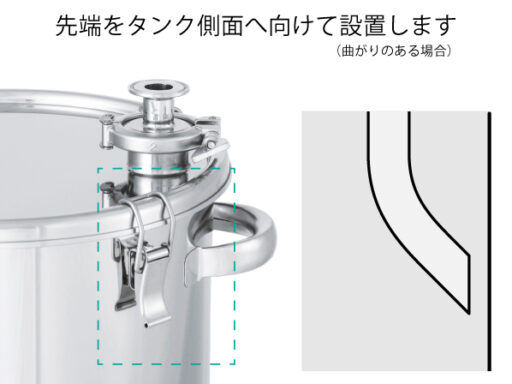
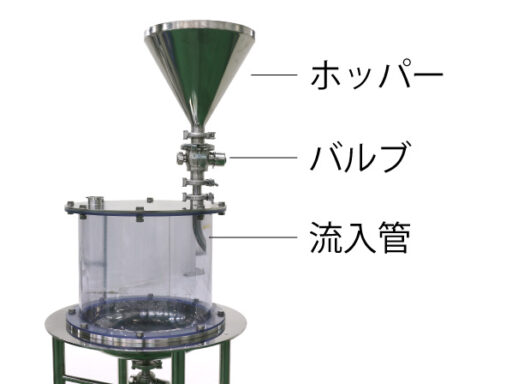
▲ An inlet pipe is used during liquid input. It has a structure that lets the liquid flow along the tank wall, slowing down the liquid’s momentum and allowing it to accumulate in the tank. In this experiment, we used it in combination with a hopper and a valve.
Result: Reduced foaming by more than half using an inlet pipe
By using an inlet pipe and inputting gradually, we significantly suppressed foaming. Though it’s a visual estimate, compared to when the lid was opened and input all at once, the amount of foam was reduced by more than half.
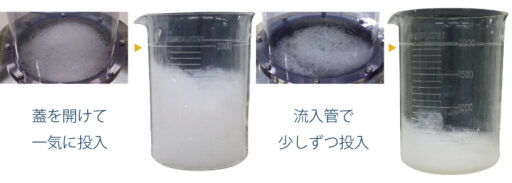
Note: The angle of the photo is different, and the liquid surface is uneven, so there might be a slight discrepancy.
Even without reducing the flow rate during input, foaming was slightly suppressed.
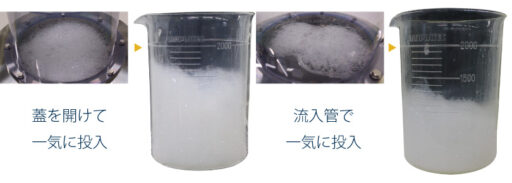
Waiting for the foam to naturally disappear takes a very long time. In this experiment, we left the foam collected in the beaker for about 2 hours, but the foam did not completely disappear.
For those troubled by foaming during raw material input, we recommend “inputting while reducing the flow rate using an inlet pipe.”
Translated by Chat GPT
https://www.nitto-kinzoku.jp/blog/blog/b-column-control-bubbling/